

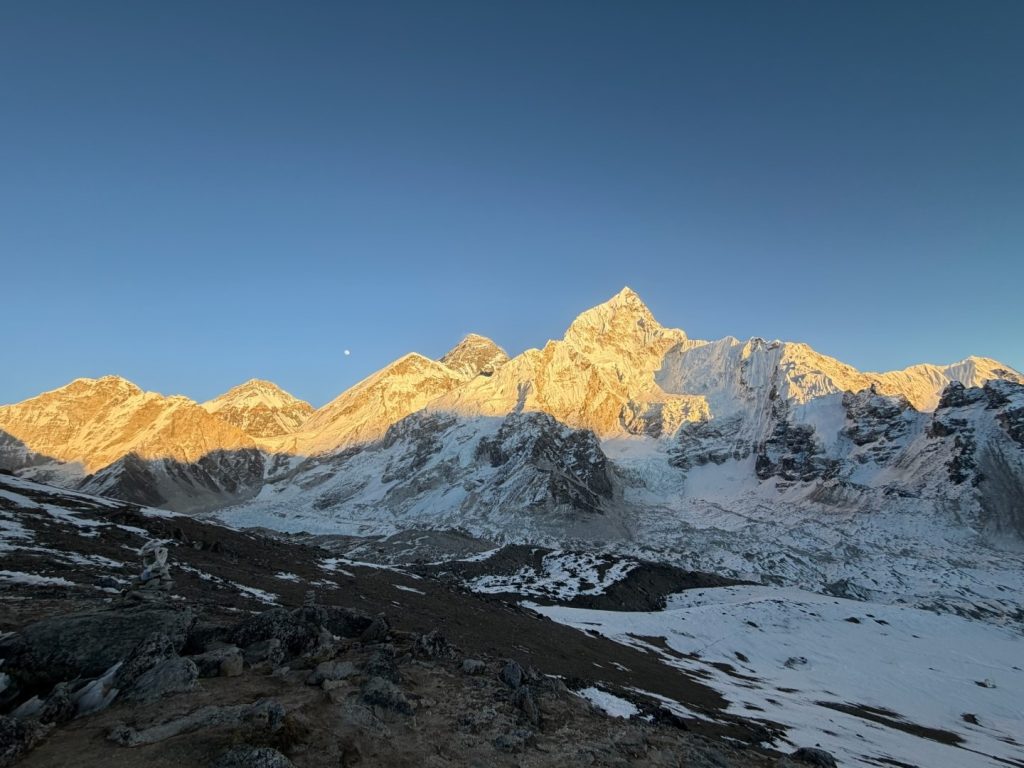
Nepal is a land of stunning mountains, rich history, and diverse cultures. It is nestled between two big countries, India and China. However, Nepal is small in geographic structure but an incredibly significant South Asian nation.
Nepal has unmatched natural beauty, cultural richness, and historical importance despite its small size. It has several intriguing facts that make it special and captivating, such as having the highest peak in the world.
This makes Nepal a beautiful land having fascinating facts that make it compelling and unique. Some of the most interesting facts about Nepal are below:
Home of the World’s Highest Mountain: Mount Everest
The world’s highest mountain, Everest, proudly lies in Nepal standing at an elevation of 8,848.86 meters (29,031.7 ft). It is often referred to as Chomolungma by Tibetan people and Sagarmatha by local Nepalese people.
The popular destination, Everest Base Camp, is a challenging trek in Nepal’s Khumbu region that attracts thrilling adventure and trekking seekers.
Mountaineers and visitors from all over the world aspire to climb this majestic peak, with many choosing the Everest Base Camp Trek to experience it up close.
However, Everest’s significance goes beyond just being a climbing destination; it is a symbol of tenacity and majesty, representing the height of both human aspirations and the natural world.
Birthplace of Lord Buddha
Nepal holds profound spiritual significance, as it is the birthplace of Siddhartha Gautama, the founder of Buddhism, one of the largest religions in the world.
Siddhartha was born in Lumbini in 563 BCE, a place now listed in the UNESCO World Heritage Site. It is the best place to have a sacred destination for millions of Buddhists all around the world.
The historical and religious importance of Lumbini extends far beyond Nepal, as it is a place of peace and enlightenment, and conveys a worldwide message of compassion.
The Only Hindu Kingdom Until 2008
Nepal was known as the only Hindu Kingdom in the world for a long time of history. Though it declared a secular republic in 2008, the religion is still embedded in Nepalese society and culture, with almost 81% of the population practicing Hinduism.
Most of the festivals, architecture, and social customs are all influenced but its unique mix of Buddhism and Hinduism, creating a fascinating fusion of rituals and customs.
Nepal’s Unique Sovereignty
Nepal has a remarkable history, as it has never been colonized unlike other countries in the area. Nepal protects its independence by negotiating treaties and agreements with the British East India Company during the era of British imperial expansion in the Indian subcontinent.
As a result, Nepal does not celebrate Independence Day, which is a rare occurrence in the global context.
Cultural and Ethnic Diversity
Nepal is a representative of cultural diversity having over 120 distinct ethnic groups and 123 languages spoken throughout its territory. Nepali is the official language, but other languages including Maithali, Newari, Bhojpuri, and Tharu are also widely spoken.
Each ethnic group contributes to Nepal’s diverse cultural tapestry by bringing its traditions, customs, and festivals. This blend of variety in tradition is also reflected in its architecture, festivals, and art forms.
World Heritage Sites in Nepal
Nepal is home to many UNESCO World Heritage Sites that highlight the rich religious heritage and ancient history. The Kathmandu valley alone contains seven such sites, including the Pashupatinath Temple, the Swayambhunath Stupa, and the Bhaktapur Durbar Square.
These places hold great religious significance and great history providing the highlight of the ancient architecture grandeur and a glimpse of some of the old dynasties.
A Unique National Flag
In the world of vexillology, Nepal’s flag stands uniquely as it is the only non-rectangular. The flag is made up of two stacked triangles, symbolize the Himalayas, and represent the two main religions of the nation: Hinduism and Buddhism.
The sun and moon illustrated on the flag are said to symbolize the hope that Nepal will endure as long as these heavenly bodies.
The Living Goddess: Kumari
The most distinctive and highly revered facet of Nepalese culture is the devotion of the Kumari. Kumari is a living goddess believed to be the physical form of the Hindu goddess Taleju.
The rigorous selection process is being done by choosing the young girls from the Newar community to become the Kumari and worshipped until they reach puberty. The living goddess’s home known as the Kumari Ghar in Kathmandu, draws thousands of tourists every year.
A Biodiversity Hotspot
Nepal is one of the world’s richest countries having a diverse biodiversity, despite its small size geographically. This makes it different from tropical lowlands to tropical highlands.
Rare and popular animals such as the red Panda, Bengal Tiger, snow leopard, and one-horned rhinoceros are found in Nepal.
This wildlife is all protected in the area like Chitwan National Park and Sagarmatha National Park, which preserve biodiversity, and Nepal’s conservation initiatives have gained praise throughout the world.
A Trekker’s Paradise
Nepal is the best trekking destination for nature and adventurer’s lovers. The country provides the most breathtaking and challenging trekking experiences in the world, with awe-inspiring routes including the Everest Base Camp trek and Annapurna Circuit.
These treks offer travellers the opportunity to explore the Nepalese culture up close in the isolated regions and communities while traversing a wide range of landscapes, from lush forests to desolate high-altitude deserts.
The Grand Festival of Dashain
Dashain is a Hindu festival and significant cultural celebrations that last for 15 days, celebrated with great fervour. This festival is a celebration in the honour of the goddess Durga.
It is a time of joy and renewal, with families gathering or reuniting, houses being decorated and cleaned, and children flying kites, which is a crucial part of Dashain celebrations.
The Brave Gurkhas
Nepal is highly popular for its best Gurkha soldiers, who have been part of the Indian and British forces for over two centuries. Gurkhas have accomplished a legendary reputation as courageous warriors with their bravery, discipline, and the slogan “Better to die than to be a coward”.
Many Gurkhas are still recruited into foreign military units these days too, demonstrating their bravery and nature of duty.
The Land of Lakes
Nepal is a land of several tranquil and beautiful lakes, each providing stunning views of the surrounding mountains. Rara Lake is the largest lake as well as the pristine beauty of Nepal lies in the remote far-western area.
Similarly, one of the popular destinations, Phewa Lake, located in Pokhara is the best for travellers looking for tranquillity amidst nature. The breathtaking views of the majestic Annapurna range reflected in its waters are like rewards to witness.
Earthquake Prone Region
The geographical location of Nepal makes it prone to earthquakes, which has affected a lot of its development and architecture. The Gorkha Earthquake that hit in 2015 with a magnitude of 7.8 on the Richter scale devastated much of the region, especially the Kathmandu Valley.
Despite these situations and challenges, Nepal has demonstrated remarkable fortitude, reconstruction efforts continue, and the country is still enthralling.
Conclusion
Nepal is a country that belies its size with the vastness of its cultural diversity, natural beauty, and spiritual importance. It offers a world of exploration, whether one is drawn to its majestic mountains, its spiritual heritage, or its friendly and diverse people.
Nepal is a place where history, culture, and environment converge to create a unique and appealing destination, from the height of Mount Everest to the holy ground of Lumbini.
